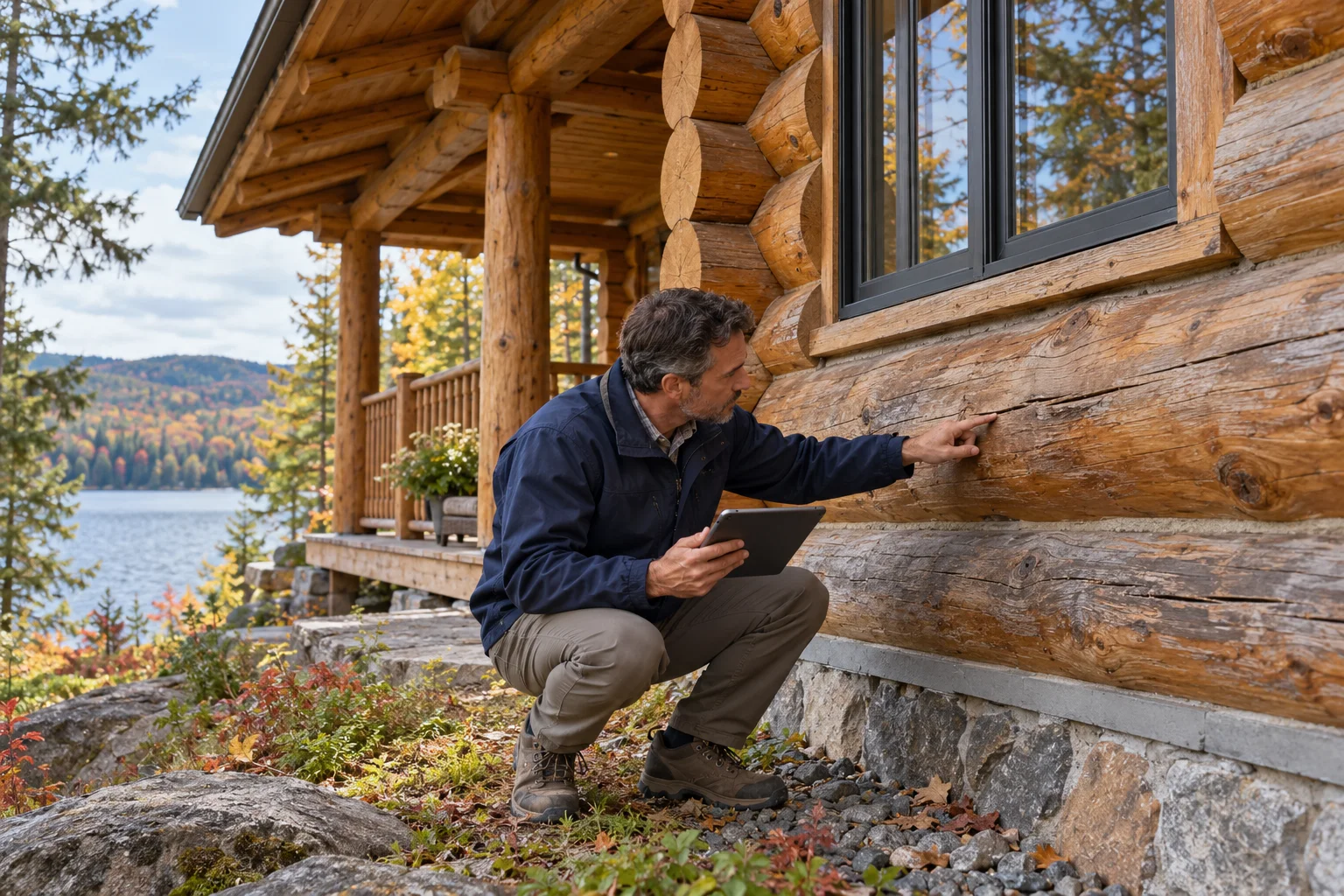
Log cottages capture the imagination. Exposed logs, the scent of pine, a lake at the edge of the property: it is easy to see why so many buyers fall in love with them. But a log cottage in the Laurentides requires different maintenance than a conventional house. Here, the wood is not hidden behind siding: it forms the structure, the walls and the exterior.
I recently inspected a lakeside log cottage in the Laurentides. This visit highlights the importance of three priorities: maintaining the logs, keeping water away and controlling moisture. Here are the observations and lessons to help better protect this type of building.
Logs: a building material that keeps moving
Wood responds to changes in moisture. It swells, shrinks as it dries, and log walls can gradually lose height as they settle. Proper construction accounts for these movements, including adjustable supports beneath certain posts and settlement gaps above doors and windows.
In the cottage inspected, the windows were installed directly in the log walls, without separate lintels or sills. Trim concealed the area where the settlement gap would be located, limiting visual verification.
An insufficient gap can place stress on the frames, causing windows to become difficult to open, deform or develop air and water leaks. The configuration of the openings and any necessary adjustments should be assessed by a contractor specializing in log construction.
Maintaining the logs to preserve their protection
Monitor the condition of exterior finishes
The finish plays an important role in protecting wood. Ultraviolet rays degrade its surface, while repeated exposure to water contributes to deterioration. A finish suitable for logs, compatible with the existing product and allowing water vapour to pass through, requires regular maintenance.
Walls exposed to sunlight and prevailing rain may weather more quickly. Maintenance frequency should reflect their condition and the manufacturer’s recommendations, rather than following the same schedule for every wall.
Before applying a new coat, prepare the surface according to the product instructions. Aggressive pressure washing can damage wood fibres: choose a cleaning method appropriate for both the wood and its finish.
Examine drying checks
Logs can develop natural cracks, known as checks, as they dry. A check alone does not establish that a structural problem exists. However, its location, orientation and exposure to water deserve particular attention.
An upward-facing check on the exterior surface can collect water. When treatment is needed, surface preparation and the choice of a flexible product compatible with logs should follow the recommendations of the manufacturer or a specialist.
Inspect the seals between logs
The joints between logs help resist air and water infiltration. Inspect them regularly, particularly for the following:
- Separation from contact surfaces.
- Cracks and breaks in the sealing material.
- Missing sections or visible gaps.
- Water stains near the joints.
An open joint can allow water, cold air and insects to enter. Repairs must accommodate wood movement and be compatible with the existing joint system.
Protect the log ends
Log ends, particularly at corners and projecting sections, are especially vulnerable to water absorption. Monitor their protection and finish, especially where they are directly exposed to the weather.
Identify early signs of deterioration
Soft or spongy wood, blistering finishes and localized deterioration are signs that warrant further assessment. The lower log courses, areas near decks and sections beneath windows deserve particular attention.
Sawdust or holes may also warrant an assessment to identify possible insect or bird activity. These signs alone do not establish their cause without further examination.
Avoid probing surfaces yourself, as this could damage them. A specialist can determine whether a log requires repair, partial replacement or another type of intervention.
Keeping water away from the cottage walls
For a log cottage, exterior water management is essential. Surface maintenance cannot compensate for constant exposure to runoff or splashing water.
- Roof overhangs: they help reduce the walls’ exposure to direct rainfall.
- Gutters and downspouts: they should remain clear and discharge water to an appropriate location away from the foundation.
- Ground slope: it should direct water away from the building rather than toward the walls.
- Clearance beneath the lower logs: ground contact and repeated splashing increase their exposure to moisture.
- Flashing: roof, chimney and wall junctions should be examined.
- Window sills: their configuration should allow water to drain to the exterior.
- Decks: their connections and slope should prevent water from becoming trapped against the logs.
At this cottage, I observed runoff stains on the chimney cricket, a raised roof feature designed to divert water. The seller had disclosed a leak at this location and stated that repairs had been completed.
When observations align with a disclosed problem, the available documents should be reviewed to determine whether further assessment is needed. An old stain alone does not prove that a leak remains active, but a reported repair does not remove the need to examine its results.
Window sills were also absent, warranting a closer assessment of how water drained away from these openings.
Finally, avoid piling firewood, vegetation or snow against the walls. Sprinklers should not direct water toward exterior wall surfaces.
Controlling moisture inside the cottage
Wood exchanges moisture with the surrounding air. Very dry conditions can make some checks more pronounced, while persistently excessive humidity can contribute to material deterioration. Proximity to a lake makes monitoring indoor conditions particularly relevant.
Measure rather than rely on impressions
A hygrometer helps track relative humidity. Readings should be interpreted in relation to the season, indoor temperature and building characteristics. In winter, condensation on windows may indicate a need to adjust humidity or ventilation.
Check ventilation and plan for periods of vacancy
Bathroom fans and the range hood should exhaust air outdoors. If the cottage has an air exchanger, its maintenance and settings should follow the equipment manufacturer’s recommendations.
For an unoccupied cottage, develop a strategy suited to its seasonal use, including heating, ventilation, monitoring and dehumidification as needed. Closing up the building without considering these factors can allow moisture problems to develop.
Do not overlook the crawl space
During this inspection, the crawl space required improvements, particularly to the ground vapour barrier and heating conditions. Moisture from this area can affect the rest of the building.
Any corrective measures should account for water management, access, insulation and the overall operation of the crawl space.
Have visible warning signs assessed
Persistent condensation, musty odours, stains and warped materials deserve particular attention. In this cottage, sagging and stained ceiling tiles could have been related to a previous leak or moisture. Their appearance alone did not establish the cause.
Testing for the possible presence of asbestos had also been recommended before any work that could disturb these materials. The presence of asbestos cannot be determined through visual observation alone.
Buying a log cottage in the Laurentides
Before buying, gather the seller’s declaration, invoices for completed work and available reports. Log maintenance dates, leak repairs and crawl space work help provide a clearer picture of the cottage’s history.
A pre-purchase inspection with INSPEXION provides an examination of accessible components within the agreed scope of the inspection. For a cottage in the Laurentides, specify its location and construction type when submitting your request so that the inspection arrangements can be confirmed.
If a leak or a specific area of deterioration requires a targeted assessment, you can also explore our building expertise service . Further assessments by a log construction specialist may be needed depending on the findings.
Protect the wood, keep water away and monitor changes
A log cottage can provide a long service life when its maintenance accounts for the material’s characteristics. Significant problems can begin with a small detail: a check exposed to water, a separated joint, a blocked gutter or an overly damp crawl space.
At INSPEXION, building inspections in Montréal and surrounding regions , a careful review of the seller’s declaration accompanies the building examination. Comparing what has been disclosed, documented and observed helps identify relevant questions before you make your decision.
Considering buying a log cottage in the Laurentides? Contact INSPEXION to tell us about the property, your concerns and your timeline.