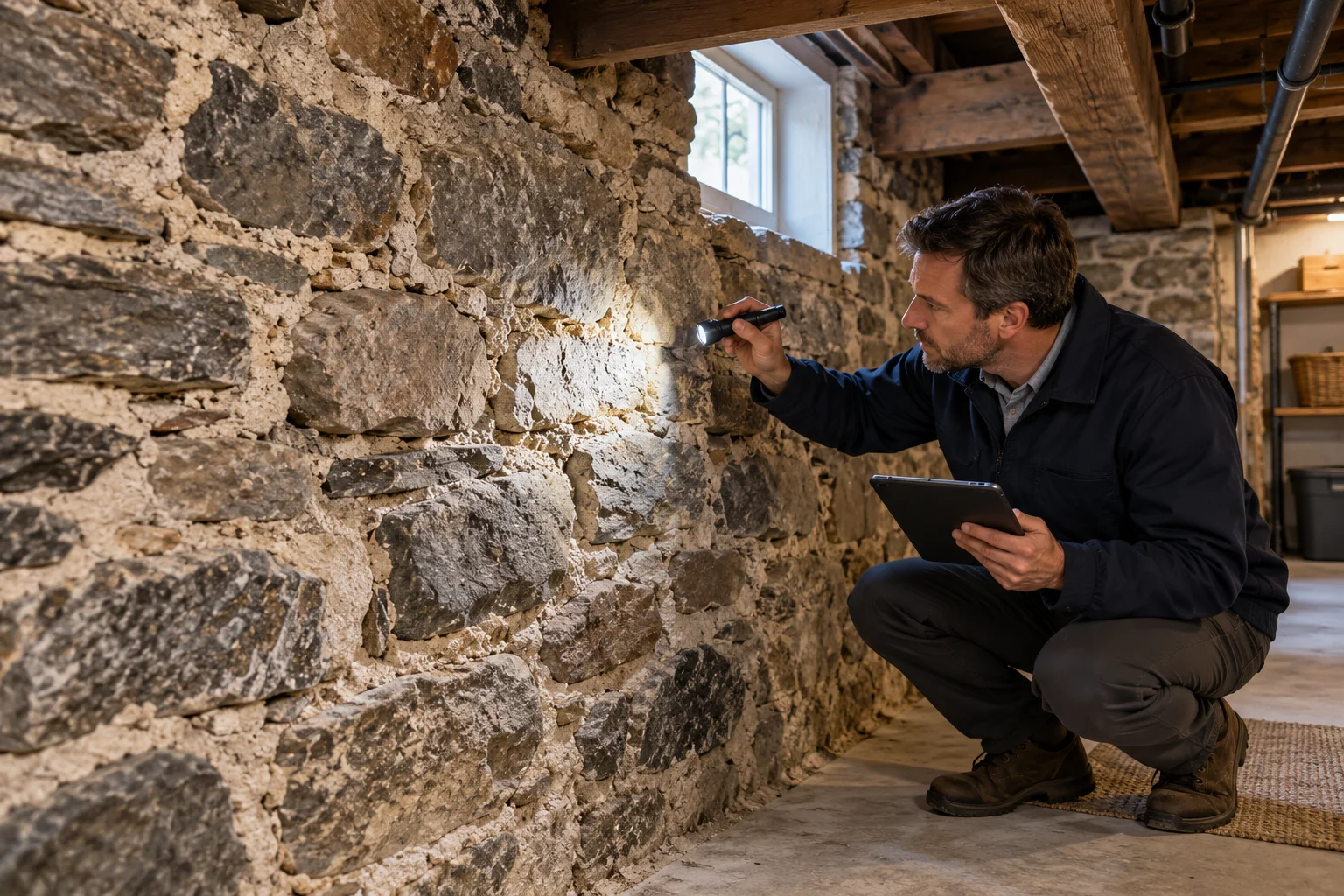
In Montréal’s Sud-Ouest borough, many row houses are more than 140 years old. Their charm is undeniable, but their foundations differ from modern concrete foundations. Maintaining a century-old foundation in Montréal requires an understanding of the original materials, moisture movement and alterations made to the building.
We recently inspected an 1880 duplex spanning three levels. Within the first few minutes, several signs caught our attention: sloping floors, a feeling of movement underfoot and cracks in the brickwork on the façades. In the basement, the rubble stone foundation was covered with spray polyurethane foam, while the mortar was crumbling in the areas that remained visible.
This case illustrates the points to examine before repairing, insulating or buying an older home. These observations provide clues: on their own, they do not establish the cause of the movement.
Understanding a rubble stone foundation
A rubble stone foundation consists of stones held together with mortar. In older buildings, this mortar is often lime-based. However, its composition and the repairs carried out over time can vary.
This masonry handles moisture differently from a modern concrete wall. Its ability to dry depends on factors such as the materials, coverings, indoor conditions and exposure to water outside.
Before any work begins, the entire system should therefore be assessed. Applying a modern solution without considering the existing wall can create new problems or conceal existing ones.
Crumbling mortar: what should be checked?
Mortar that has become crumbly, sandy or is missing from the joints warrants assessment. Prolonged exposure to water, freeze-thaw cycles and the presence of salts can contribute to its deterioration.
As joints erode, they can allow water to enter more easily and leave parts of the masonry less securely held together. The extent of the deterioration, the arrangement of the stones and any deformation should be examined.
Choosing a compatible mortar for repointing
Repointing involves removing deteriorated mortar using an appropriate method, then renewing the joints. The choice of product should not be based solely on its strength.
Mortar that is too rigid or incompatible with the stone and existing joints can change how the masonry behaves and contribute to its deterioration. The appropriate formulation should be determined by a specialist in historic masonry.
To better understand these foundations, you can also consult this French-language resource from Maisons anciennes du Québec on stone masonry foundations .
Spray polyurethane foam on an older foundation: an intervention that requires assessment
Insulating a cold basement can improve comfort in the building. However, applying insulating foam to a rubble stone foundation requires consideration of the wall’s condition, water infiltration, drying potential and the characteristics of the chosen system.
In the duplex inspected, spray foam covered much of the foundation. The main inspection limitation was the inability to directly observe the concealed stones and mortar joints.
- Moisture management: insulation changes the wall’s temperatures and moisture movement. Sources of water should be assessed before a solution is selected.
- Masonry visibility: a covering can conceal deteriorated joints, cracks or signs of water infiltration.
- Fire protection: applicable requirements for protecting the foam should be verified based on the product, its location and the assembly.
The presence of foam alone does not prove that the foundation is damaged. When concerning signs are visible, a specialist may recommend selective openings, made with the appropriate authorization and precautions.
Before insulating a century-old foundation, consult a professional who can assess the masonry and the moisture management strategy.
Keeping water away from the foundation
Limiting the water that reaches the walls remains a priority. Repairing mortar joints does not resolve persistent water accumulation at the base of the building.
- Maintain the gutters: remove debris and check for overflowing.
- Check the downspouts: direct water to an appropriate location, without concentrating it near the foundation or on a neighbouring property.
- Examine ground slopes: identify areas where water collects, particularly in the backyards of row houses.
- Check exterior junctions: have gaps between paved surfaces and walls assessed before choosing a repair method.
- Monitor indoor humidity: measure basement conditions and adjust ventilation or dehumidification as needed.
Protection against sewer backups is a separate issue. A plumber can assess the necessary devices, their configuration and their maintenance. A backwater valve does not replace measures to manage water infiltration through foundation walls.
Sloping floors and cracks in brickwork: how should these signs be interpreted?
In a building more than 140 years old, a floor slope may be longstanding and stable. However, it should not be considered normal solely because of the property’s age.
A feeling of movement, sagging that appears to be progressing or cracks that have visibly changed warrant further investigation. A single visit does not always establish whether a crack is active.
Possible causes include:
- Deterioration at beam or joist bearing points.
- Previous alterations to load-bearing components.
- Notches or holes in structural members.
- Movement of the foundation or individual supports.
- Problems specific to the masonry veneer.
In a row house, party walls and work carried out on neighbouring buildings may also need to be considered. These possibilities do not constitute a diagnosis of the duplex inspected.
Document the conditions and consult before repairing
Keep dated photographs and clearly identify the locations of cracks. A professional can specify an appropriate monitoring method and determine whether an assessment by a structural engineer is needed.
Do not begin excavation near or beneath an older foundation, particularly to lower the basement floor, without a prior structural assessment and appropriate plans. Poorly planned work can compromise the building’s supports.
Pre-purchase inspection of an older home in Montréal
Before buying, gather the seller’s declaration, previous reports and documents relating to repairs. Foundation work, disclosed water infiltration and structural alterations are particularly useful to understand.
A pre-purchase inspection in Montréal helps identify visible signs and the limitations encountered within the scope of the inspection. It may lead to recommendations for further assessments before you make your decision.
For a specific concern, our building expertise service in Montréal provides an opportunity to discuss an assessment suited to the issue raised. Depending on the situation, an examination by a specialized mason or an engineer may be necessary.
Preserving a century-old foundation by respecting its materials
Age alone does not determine a foundation’s condition. Water management, the quality of repairs and alterations to the building all play important roles.
Maintaining a rubble stone foundation means limiting its exposure to water, understanding its drying conditions, using compatible materials and monitoring signs of change. Concealing a wall or a crack does not replace an assessment of its condition.
Considering buying a duplex or an older home in the Sud-Ouest? INSPEXION, building inspector in Montréal , helps you examine accessible components and directs you toward relevant assessments when required by the scope of the inspection.
Contact our team to tell us about the property, its known history and your timeline.